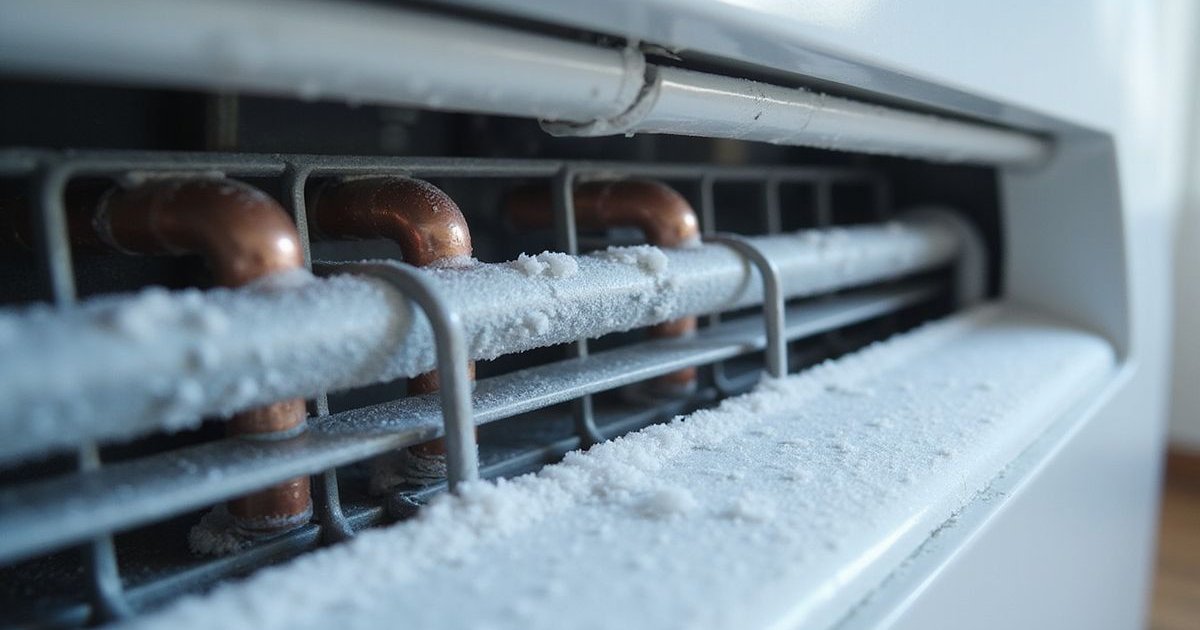
Seeing ice on your air conditioner is confusing. You are running the machine to cool down your home in the humid heat of Kuala Lumpur, yet the unit itself looks like a freezer.
This isn’t normal.
Ice formation indicates a significant failure in the heat exchange process. Ignoring this leads to water leakage on your walls and eventually kills the compressor.
We handle these cases daily across Kepong and Mont Kiara. Most homeowners assume it just needs “gas,” but the reality is often more specific.
Here is exactly why this happens and how to fix it before permanent damage occurs.
Why Ice Forms (The Science)
Your AC works on a simple principle of heat absorption. The indoor evaporator coil typically operates between 4°C and 7°C.
Air from your room blows over these cold copper coils. The heat is absorbed into the refrigerant, and the cooled air is pushed back out.
Ice takes over when that coil temperature drops below 0°C.
In Malaysia’s high-humidity environment, your AC is constantly pulling moisture from the air. If the coil gets too cold, that condensation freezes instantly.
Once the first layer of frost appears, it acts as an insulator. This blocks the remaining airflow, causing the coil to get even colder.
The ice spreads rapidly until the entire unit is a solid block.
Where Ice Forms
You might spot the problem in three distinct areas.
Indoor Unit
- The Evaporator Coil: This is the metal grid behind your filters.
- Air Outlet Vents: You might see frost or “snow” blowing out.
- Plastic Casing: Condensation may freeze on the exterior if the blockage is severe.
Outdoor Unit
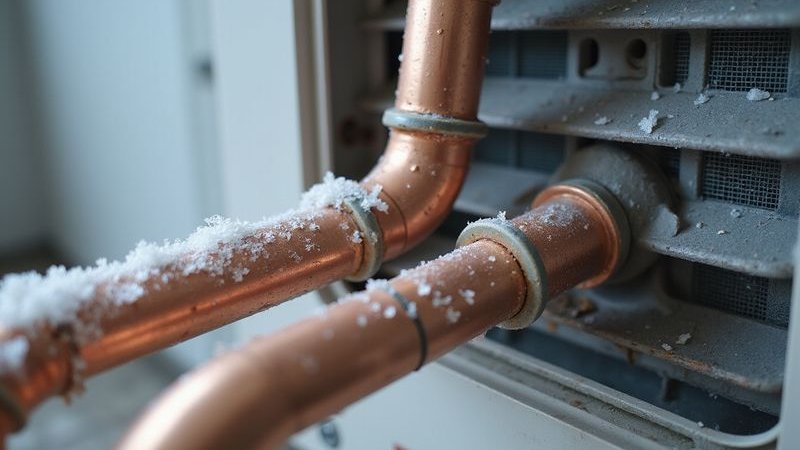
- Service Valves: These are the brass connection points on the outdoor condenser.
- Copper Piping: The insulated pipes connecting the indoor and outdoor units may turn white with frost.
Cause #1: Dirty Air Filter (Most Common)
A clogged filter is the culprit in nearly 40% of the cases we visit.
What happens: Your AC needs a steady volume of warm room air to keep the coil temperature above freezing. A layer of dust blocks this airflow.
Without enough warm air, the refrigerant inside the coil drops the metal temperature below 0°C. The moisture in the air hits this sub-zero surface and snaps into ice.
Signs:
- You can see a thick layer of grey dust on the filter mesh.
- Airflow from the vents feels weak or uneven.
- Ice is concentrated on the evaporator coil rather than the copper pipes.
Fix:
- Turn off the AC immediately to stop the freezing cycle.
- Open the front cover and remove the filters.
- Wash them with water and let them dry.
- Restart the unit only after the ice has melted naturally.
Prevention: Check your filters every two weeks. In dusty urban areas like KL, monthly cleaning is mandatory.
Cause #2: Low Refrigerant (The Leak)
Refrigerant does not “used up” like petrol. It circulates in a closed loop.
What happens: If the gas level drops due to a leak, the pressure inside the system changes. According to the laws of thermodynamics, a drop in pressure leads to a drop in temperature.
The remaining gas expands too much as it enters the cooling coil. This flash-expansion drives the temperature down to -10°C or lower, causing instant freezing.
Signs:
- Ice appears on the thin copper pipe at the outdoor unit.
- The air coming out is not cold, even before the ice forms.
- You might hear a faint hissing noise near the pipe connections.
Fix: We must locate the leak before adding gas. Topping up R32 or R410A gas without fixing the leak is a waste of money because it will leak out again in a few weeks.
A technician will braze the leak or re-flare the copper connection.
Cause #3: Dirty Evaporator Coil (Biofilm Buildup)
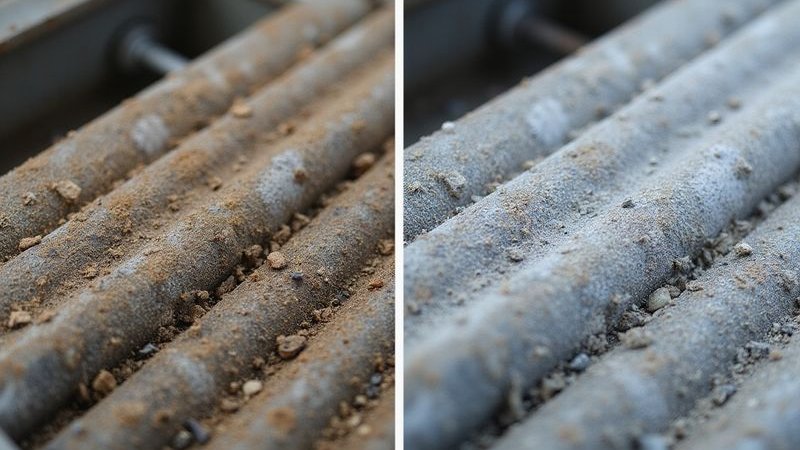
Cleaning the filters is not always enough. Micro-dust passes through standard filters and sticks to the damp coil fins.
What happens: Over 12 to 18 months, this dust mixes with condensation to form a “jelly” or biofilm. This layer prevents the heat from your room from reaching the refrigerant.
The refrigerant stays cold because it isn’t absorbing heat. The moisture on the “jelly” layer then freezes.
Signs:
- Your filters are clean, but ice still forms.
- The air smells musky or sour (a sign of bacterial growth).
- You haven’t had a chemical wash in over a year.
Fix: This requires a chemical wash. We use an alkaline-based solution to penetrate the coil fins and wash out the impacted dirt that water alone cannot remove.
Cause #4: Blower Fan Issues
The cylindrical fan inside your indoor unit is responsible for moving air.
What happens: If the fan motor is failing or the capacitor is weak, the fan spins slower than the design speed. Low airflow causes the same freezing effect as a dirty filter.
Dirt can also cake onto the fan blades. This adds weight and creates drag, slowing the air movement significantly.
Signs:
- Airflow is weak even when you set the remote to “High” fan speed.
- The unit vibrates or makes a rhythmic “whooshing” sound.
- The fan stops and starts randomly.
Fix: A technician needs to test the fan motor capacitor. If the capacitor is healthy, the blower wheel likely needs to be removed and chemically cleaned.
Cause #5: Thermostat and Sensor Faults
Your AC relies on sensors to know when to turn the compressor off.
What happens: A thermistor (temperature sensor) can become dislodged or fail. If it touches the cold metal coil directly, it might give a false reading.
Alternatively, a faulty Printed Circuit Board (PCB) might keep the compressor running continuously. The coil eventually gets too cold because the unit never takes a break.
Signs:
- The room gets freezing cold, far below your setting.
- The outdoor unit continues running even when you turn the indoor unit off (rare relay failure).
- Ice forms despite perfect airflow and gas levels.
Fix: Electronic diagnosis is required. We typically replace the copper or resin sensor, which is a quick and affordable repair.
Comparison: Is It Dirt or Gas?
Use this table to help identify the likely culprit before you call for help.
| Symptom | Probable Cause | Action Needed |
|---|---|---|
| Ice on Coil Only | Dirty Filter or Blower | Clean filter / Chemical Wash |
| Ice on Pipes + Coil | Low Refrigerant | Leak Repair + Top Up |
| Weak Airflow | Fan Motor / Dirty Coil | Chemical Wash / Motor Repair |
| Unit Runs Non-Stop | Sensor / PCB Failure | Part Replacement |
How to Safely Defrost Your AC
You cannot repair the unit while it is a block of ice. Follow this procedure immediately.
Step 1: Switch to Fan Mode
Grab your remote and change the mode from “Cool” to “Fan.” Keep the fan speed on high. This forces warm room air over the ice to melt it safely.
Step 2: Manage the Water
Place old towels or a bucket under the unit. A defrosting coil releases a significant amount of water. This can overwhelm the drain tray and spill onto your floor.
Step 3: Be Patient
It usually takes 2 to 4 hours to fully defrost a frozen unit in Malaysia’s humid climate.
Step 4: Inspect the Filter
Check the filter once the ice is gone. If it is clogged, clean it.
What NOT to Do
Do not use a hair dryer. The intense heat can warp the plastic casing and damage the sensitive electronics on the PCB.
Do not chip the ice with a knife. The copper tubes in the coil are thin and fragile. One slip will puncture the coil, releasing all your refrigerant and ruining the unit.
Do not pour hot water on the coil. Thermal shock can crack the metal or plastic components.
When to Call a Professional
Homeowners can handle basic filter cleaning. However, you need a certified technician if:
- The ice returns immediately after you clean the filter.
- You see ice on the copper pipes outside (this confirms a gas issue).
- The unit is leaking water heavily along with the ice.
- It has been more than 12 months since your last professional service.
Prevention Checklist
Keeping your AC ice-free is cheaper than replacing a compressor.
Monthly:
- Remove and wash the mesh filters.
- Wipe down the air vents.
Every 6 Months:
- Schedule a general service to check gas pressure (PSI).
- Inspect the blower fan for dust buildup.
Every 12 Months:
- Perform a chemical wash to clear the deep biofilm from the coil.
- Check the insulation on the copper pipes for tears.
Get Your Frozen AC Fixed
Is your AC icing up repeatedly? We serve Kepong, Mont Kiara, Desa ParkCity, and the surrounding Kuala Lumpur areas.
WhatsApp us at 012-2252 623 to schedule a diagnosis.
Our standard service package covers:
- Complete system inspection (Indoor & Outdoor).
- Refrigerant pressure analysis (R32/R410A).
- Chemical wash for the evaporator and condenser (RM180/unit).
- 30-day workmanship warranty.
Don’t let a frozen coil turn into a dead compressor. Get it checked today.